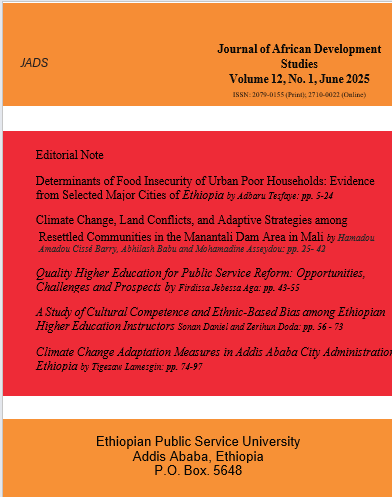
Climate Change, Land Conflicts, and Adaptive Strategies among Resettled Communities in the Manantali Dam Area in Mali
DOI:
https://doi.org/10.56302/jads.v12i1.13904Keywords:
Host Villages; Land Conflicts; Manantali Dam; Resettlement; Impoverishment Risks; Climate Change AdaptationAbstract
The construction of the Manantali dam in the early 1980s in Mali considerably altered the socio-economic and environmental landscape, displacing communities and submerging natural habitats. These displacements led to tensions over land sharing due to population growth and resource scarcity, fostering conflicts between resettled and host villages. Based on semi-structured interviews and direct observations in thirteen villages, this study examines land-related conflicts from the perspective of Cernea's Impoverishment Risk and Reconstruction (IRR) model, focusing on risks such as landlessness and social marginalisation. Forty-five indepth interviews reveal how population density and agricultural migration exacerbate competition for arable land, while traditional and formal conflict resolution mechanisms struggle to resolve disputes effectively. This article provides new perspectives by exploring how strategies for adapting to climate change, such as agroecological practices, influence land conflicts and community resilience. It also criticises governance failures in resettlement planning and advocates participatory approaches to resource management. The findings support policy recommendations for sustainable land governance and community-led adaptation, filling gaps in existing studies on development-induced displacement.
Downloads
Published
How to Cite
Issue
Section
License
Copyright (c) 2025 Journal of African Development Studies

This work is licensed under a Creative Commons Attribution-NonCommercial-ShareAlike 4.0 International License.